Friday, 14 June 2013

20 years in Harrow

Our Parish Priest, The Very Reverend Protopresbyter Fr. Anastasios D. Salapatas, and his family, celebrate today their 20th Anniversary of Service in our Sacred Parish of St. Panteleimon. They arrived here on 14th June 1993.


They had previously served at the historic Hellenic Community of St. Nicholas in Cardiff of South Wales, which had been established in 1873 by Greek sailors.


The Leaders and the people of St. Panteleimon had embraced Fr. Anastasios and his family from the very beginning, establishing with them good communication and excellent co-operation.


In the first hours of their being in our Community many people, both male and female, had visited the new Priest and his young family, offering flowers, smiles and sincere love, on which they had built a very successful and fruitful relationship. Some of those people are no longer with us, having been moved to the Triumphant Church in the Heavens.


From the very next day Fr. Anastasios and his family started their dedicated Service in our Community, in the Church, at our Greek School, visiting the sick at the local hospitals… Our Community hadn’t acquired at the time its own Ecclesiastical and Community premises. Today it has! We worked all together very hard over the next years in order to purchase and secure them for our own use.


With the help, the blessing, the enlightenment and the inspiration from our Holy God we will continue our way forward and we are certain that we will succeed even greater targets, reaching high aims, to the glory of our Great Poet and Maker and to the spiritual benefit of all the members and friends of our progressive Community!

Friday, 7 June 2013

Vespers of Love

Easter Sunday afternoon, the faithful gather once more for prayer with lighted candles. All sing the hymn, "Christ is Risen from the Dead."


The people greet one another joyously, saying: "Christ is Risen," the Easter salutation which is answered, "Truly He is Risen."


They sing, "The dark shadows of the Law have passed away by the coming of grace," and standing in exaltation, they exclaim, "Who is so great a God as our God?"

The Gospel according to Saint John (20, 19-25) is read in various languages, proclaiming the Good News of Resurrection all over the universe without discrimination.


The fruit of faith in the Resurrection of the Lord is love in His Name; therefore, this day is called "Sunday of Agape" (love feast), a day dedicated to Christian principles, especially to forgiveness and charity.

At this time, Christians seek to end misunderstanding and arguments among those with whom they may be at odds.


Apostle Paul firmly interprets the Resurrection of Christ, saying: "If Christ has not been raised, then our preaching is in vain and your faith is in vain" (1 Cor. 15, 14).


The Church also states in its Creed, "The Third day He rose again".

Thursday, 6 June 2013

Holy Saturday Evening - Easter Sunday

The Holy Service celebrated on that Evening is Matins and then the Divine Liturgy of Sunday morning sung Saturday midnight. With this service, the Pentecostarion starts (50 days services).

This Evening we celebrate the life-giving Resurrection of our Lord and Savior Jesus Christ.


Before midnight, the Odes of Lamentation of the previous day are repeated.


The Orthros of the Resurrection begins in complete darkness. The priest takes light from the vigil light and gives it to the faithful, who are holding candles.


The priest sings: "Come ye and receive light from the unwaning life, and glorify Christ, who arose from the dead," and all the people join him in singing this hymn again and again.


From this moment, every Christian holds the Easter candle as a symbol of his vivid, deep faith in the Resurrection of Jesus Christ as Saviour.


In our church, the priest led the people outside the church, where he had read the Gospel which refers to the Angel's statement: "He is Risen; He is not here" (Mark 16, 1-8).

Then comes the breathless moment as the people wait for the priest to start the hymn of Resurrection, which they join him in singing, repeatedly: "Christ has Risen from the dead, by death trampling upon Death, and has bestowed life upon those in the tombs."


From this moment, the entire Service takes on a joyous Easter atmosphere. The hymns of the Odes and Praises of Resurrection which follow are of superb meaning and expression.


The people confess, "It is the Day of Resurrection, let us be glorious, let us embrace one another and speak to those that hate us; let us forgive all things and so let us cry, Christ has arisen from the dead." By this hymn, they admit that love of one's fellowman is the solid foundation of the faith in the Resurrection of Christ.


The Divine Liturgy of St. John Chrysostom is then officiated. At the end of the Liturgy, a part of the marvellous festival sermon of St. Chrysostom is read, which calls upon the people to "Take part in this fair and radiant festival. Let no one be fearful of death, for the death of the Saviour has set us free... O Death, where is thy sting? O Hades, where is Thy victory? Christ is Risen and Thou art overthrown. To Him be glory and power from all ages to all ages."

Wednesday, 29 May 2013

Holy Saturday Morning

"Arise, O God, and judge Thou the earth..."

The service is Vespers and Divine Liturgy of Saturday evening sung by anticipation, on Saturday morning.


Psalms are read and Resurrection hymns are sung which tell of Christ's descent into Hades. "Today Hades cried out groaning" is the hymn's description of the resurrection of Adam and the conquering of death. Thus this day's celebration is called "First Resurrection".


Most of the readings of this day are from the Old Testament on the prophecies and promise of the conquering of death.


On this day, the Divine Liturgy of St. Basil is officiated. Apostle Paul exhorts the faithful: "We were buried, therefore, with him by baptism unto death, so we, too, might walk in newness of life" (Romans 6:4).


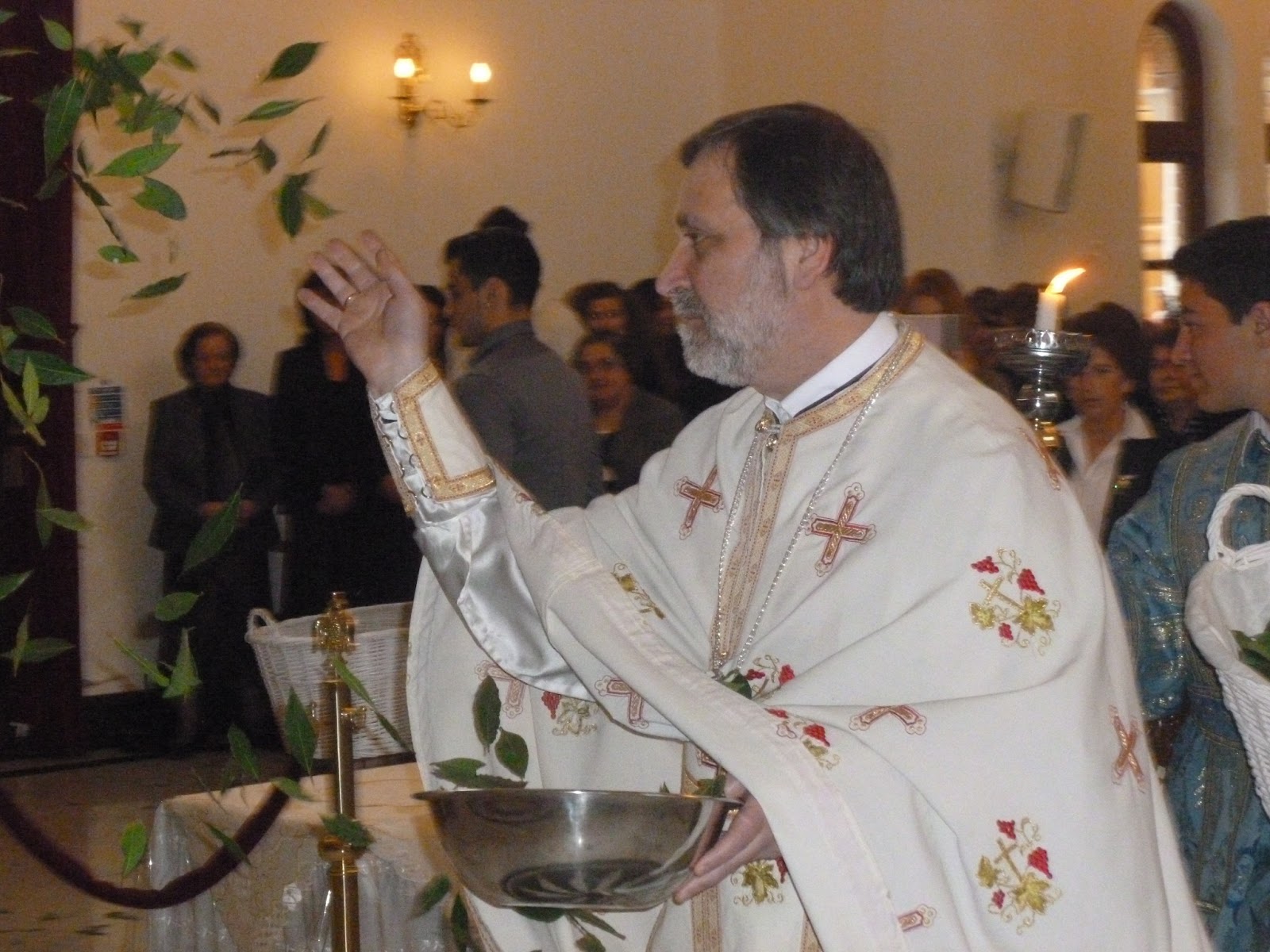
After the reading of the Epistle, the priest follows the custom of tossing of laurel, saying: "Arise, O God, and judge Thou the earth: for Thou shall take all heathen to Thine inheritance".


The Cherubic hymn of this day is: "Let all mortal flesh keep silence and stand with fear and trembling...", a thoughtful hymn of adoration and exaltation.


The Divine Liturgy ends with the Communion Hymn: "So the Lord awaked as one out of sleep, and He is risen to save us".

Saturday, 25 May 2013

Holy Friday Evening

The Lamentations

The service is Matins of Holy Saturday morning sung by anticipation, on Holy Friday evening.

It consists of psalms, hymns, and readings dealing with the death of Christ, in contrast to His divinity, and in expectation of His Resurrection.


One of the hymns relates: "He who holds all things is raised up on the Cross and all creation laments to see Him hang naked on the Tree".


The thoughtful and well-written Odes, sung by the choir, compare the Compassion of God and the cruelty of man, the Might of God and the moral weakness of man.


The Odes picture all Creation trembling when witnessing its Creator hung by His own creatures: "Creation was moved...with intense astonishment when it beheld Thee hung in Golgotha".


The Odes remind us of the vision of Isaiah, who saw Christ, "the unwaning light of the manifestation," and cried aloud, "The dead indeed shall arise and all those on earth shall rejoice".


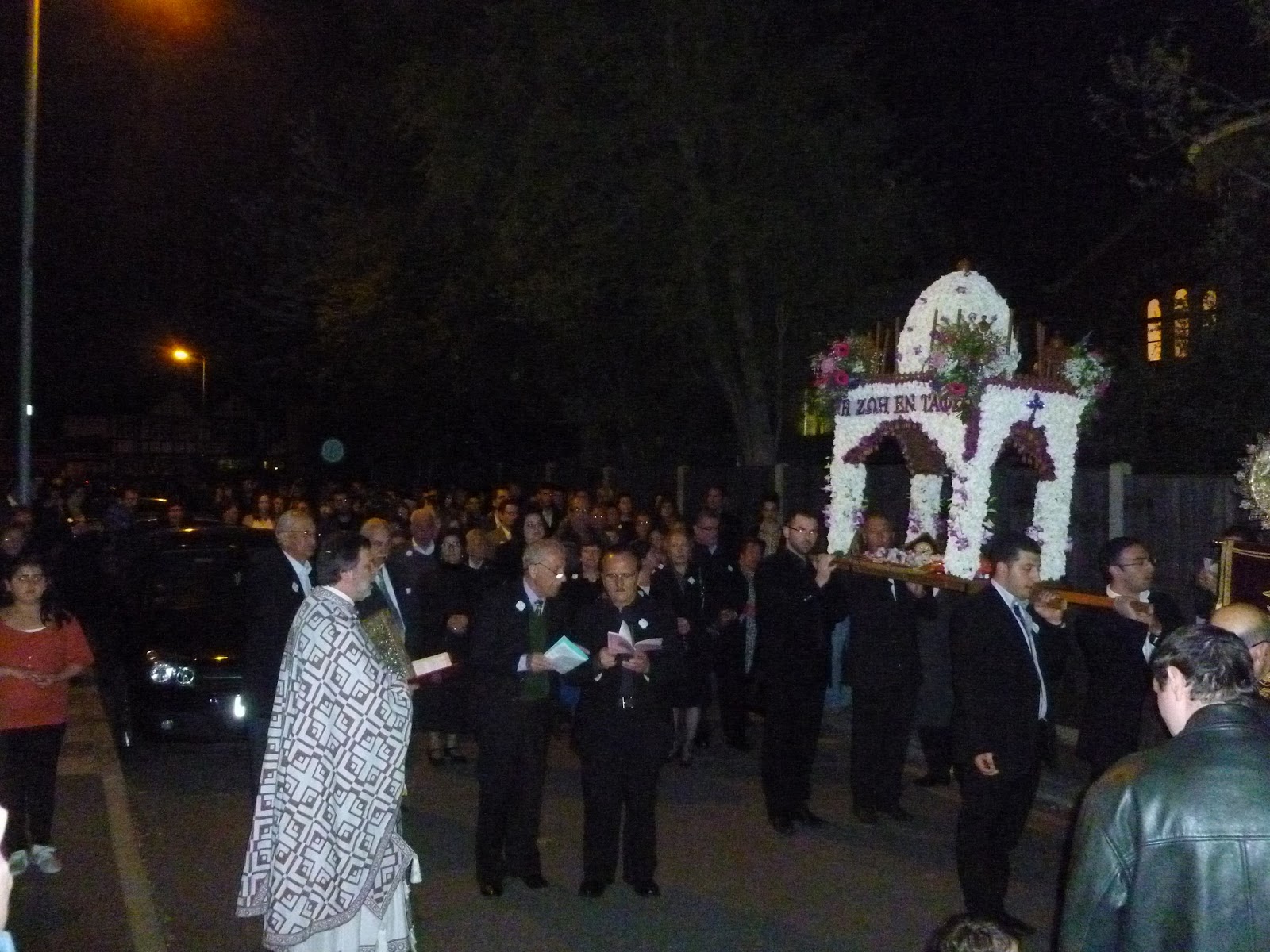
During this service, the Epitaphion with the sacred Body of Christ in it is carried in procession around the church and around the neighbourhood.

The entire congregation joins in singing the three parts of the "Hymns of Praise".


After these hymns are sung, the priest sprinkles the Epitaphion and the whole congregation with fragrant water.


There is a simultaneous praise of both the Crucifixion and Resurrection of Christ with their purpose of the redemption of man.


We no longer lament the sufferings of the Crucified One; we now lament chiefly for our own sins because we are far from God.


So these services should have a rather personal meaning of repentance and of strong faith in God.

Christians observe Good Friday with fasting, prayer, cleanliness, self-examination, confession, and good works, in humility and repentance so that the Grace of the Cross might descend upon them.


The Gospel reading is Matthew 27, 62-66.

Monday, 13 May 2013

Holy Friday Morning / Afternoon


According to the Hebrew custom, the "Royal Hours", four in number, are read on Holy Friday Morning.


These services consist of hymns, psalms, and readings from the Old and New Testaments, all related prophetically and ethically to the Person of Christ.


During this time the Ladies of our Church are decorating the Epitaphion at the Church Hall.


When it is ready they bring it into the Church and place it in front of the Icon Screen and the Royal Doors.


Around that time and as a continuation of the Royal Hours we chant the Service of Vespers of Holy Friday.

During this service, the removal of the Body of Christ from the Cross is commemorated with a sense of mourning for the terrible events which took place.


Once more, excerpts from the Old Testament are read together with hymns, and again the entire story is related, followed by the removal from the Cross and the wrapping of the Body of Christ with a white sheet as did Joseph of Arimathea.


Apostle Paul, interpreting the dreadful event, exhorts the Church: "For the word of the cross is folly to those who are perishing, but to us who are being saved it is the power of God... we preach Christ crucified... the power of God and the wisdom of God." (1 Cor. 1: 18f).

As the priest reads the Gospel, "and taking the body, Joseph wrapped it in a white cloth," he removes the Body of Christ from the Cross, wraps It in a white cloth, and takes It to the altar.


The priest then chants a mourning hymn: "When Joseph of Arimathea took Thee, the life of all, down from the Tree dead, he buried Thee with myrrh and fine linen... rejoicing. Glory to Thy humiliation, O Master, who clothest Thyself with light as it were with a garment."


The priest then carries the cloth on which the Body of Christ is painted or embroidered around the church before placing It inside the Epitaphion, which symbolizes the Tomb of Christ.


We are reminded that during Christ's entombment, He descends into Hades to free the dead of the ages before His Incarnation.


Holy and Great Friday is the only day in the year on which the Divine Liturgy is not officiated.

On that day, the devoted Christian ponders in his heart the deep meaning of the Seven Last Words of Christ uttered on the Cross, the first Divine Pulpit of Christianity.